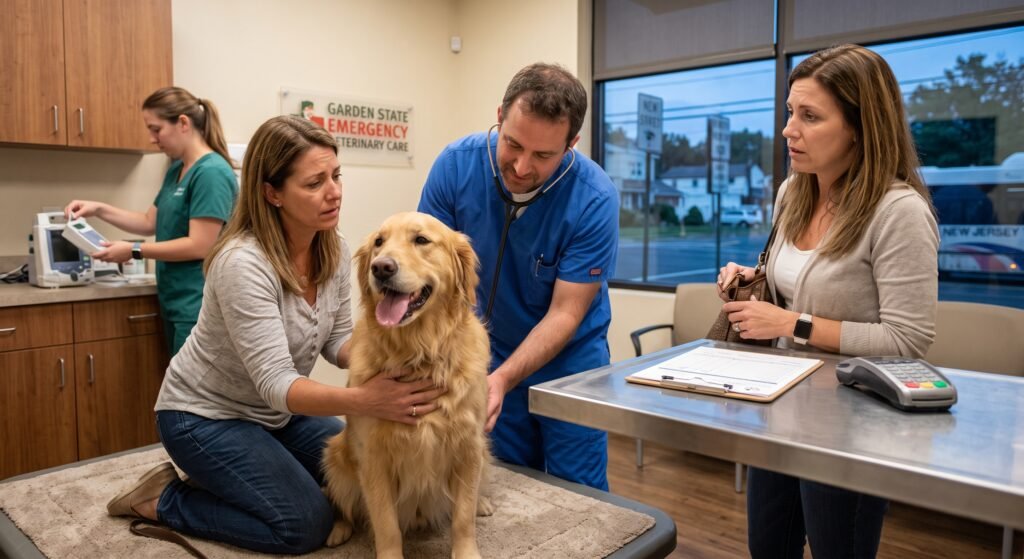
If you’re dealing with an emergency right now: go, and call on the way. Every emergency hospital triages on arrival, and cost is discussed after your pet is stable — not at the door.
When you do talk numbers, ask for a written treatment estimate before authorising anything. You are allowed to ask what each line is for, and which parts can wait. Good ER staff expect that question and will give you a high and a low estimate.
Nobody researches this calmly. Most people find a page like this at eleven at night with a dog that won’t stand up, or the morning after a bill they weren’t expecting. So here is the number first, and the explanation after it.
$1,080 – $3,750 What emergency and urgent conditions typically cost in New Jersey, based on pricing data from roughly 70 veterinary clinics across the state. A simple walk-in exam can be as little as $150. Anything involving surgery and a few nights in intensive care runs past $5,000.
That’s a wide range, and the width is the point. What determines where you land isn’t really your pet’s diagnosis — it’s how many nights they stay and whether they need a surgeon. Understanding how the bill is assembled is the difference between feeling ambushed and being able to ask useful questions.
How an emergency vet bill is actually built
Emergency medicine is priced in layers. Almost every bill starts the same way and then diverges sharply depending on what the first layer finds.
| Line item | Typical range |
|---|---|
| Emergency exam / triage fee Charged on arrival, before anything is diagnosed. This is the door charge. | $150 – $300 |
| Bloodwork CBC and chemistry panel. Ordered on almost every genuine emergency. | $80 – $300 |
| X-rays Usually multiple views. Standard for suspected obstruction, trauma or breathing trouble. | $150 – $400 |
| Ultrasound Added when they need to see organs or check for internal bleeding. | $300 – $600 |
| Hospitalisation, general Per day. Fluids, monitoring, nursing care. | $200 – $600 / day |
| Intensive care Per day at a 24-hour facility. Continuous monitoring, oxygen, critical nursing. | $500 – $1,500 / day |
A visit that stops after triage, bloodwork and an X-ray — which describes a great many of them — lands somewhere around $400 to $1,000. The bills that shock people are the ones where the X-ray finds something, and the layers keep stacking.
What common emergencies cost
These are treatment-complete ranges, including diagnostics, surgery where required, and the associated hospital stay.
| Emergency | Typical total |
|---|---|
| Foreign object ingestion Surgical removal. The classic sock, corn cob or toy. | $2,000 – $5,000 |
| Broken bone Repair, pinning or plating, plus follow-up. | $1,500 – $4,500 |
| Urinary blockage Common and genuinely life-threatening in male cats. | $1,500 – $4,500 |
| Walk-in exam, no treatment You came in, they looked, nothing further needed. | from $150 |
| Major surgery with ICU stay Bloat, hit-by-car, complex abdominal surgery. | $5,000+ |
Why New Jersey runs higher than the national figure
The same three things drive it everywhere, and all three are working against us here.
Density and overhead. New Jersey is the most densely populated state in the country, and the commercial rent, wages and insurance that a 24-hour hospital carries are priced accordingly. That flows straight into the exam fee.
Specialty consolidation. Much of the state’s genuine emergency capacity now sits inside large specialty referral hospitals with board-certified criticalists, advanced imaging and round-the-clock staffing. That’s excellent medicine and it is not cheap. A general practice that stays open late is a different price point from a specialty ER, and both call themselves emergency care.
Proximity to two major metros. North Jersey prices against New York, South Jersey against Philadelphia. Neither is a cheap market.
As a rough sanity check on the direction: pet insurance premiums in New Jersey run about 6% above the national average, and premiums are priced off claim costs. The insurers have already done this arithmetic.
If you can’t pay tonight
This is the part most cost articles skip, and it’s the part that actually matters. There are more options than most people know about, and several can be arranged from your phone in the waiting room.
Tell the hospital immediately
Not after the treatment plan — at the start. Say plainly what you can afford. Emergency vets have this conversation constantly and it is not held against you. They can often stage treatment: stabilise now, diagnostics tomorrow, or treat the immediate threat and refer the rest to your regular vet at lower cost. What they cannot do is work around a budget they don’t know about.
Financing you can apply for on the spot
- Scratchpay — designed for veterinary care. Application on your phone, decision in minutes, and it uses a soft credit check rather than a hard pull. Generally the first thing to try if CareCredit turns you down.
- CareCredit — widely accepted health-care credit card, often with a promotional interest-free window. Runs a full credit check.
Grants, and the tactic most people miss
Apply to several at once. These funds routinely each cover a portion of a bill rather than the whole thing, and they expect to be stacked. Applying to one and waiting is the common mistake.
- RedRover Relief — emergency care grants, open to households earning up to about $60,000 a year.
- Frankie’s Friends — emergency and specialty care where the prognosis is good.
- Bow Wow Buddies Foundation — grants up to $2,500, dogs only.
- DaisyCares — Hope & Health grants up to $1,000.
- The Pet Fund — worth knowing about, but read the criteria: it covers chronic conditions such as cancer and heart disease, not acute emergencies.
Best Friends Animal Society maintains a directory of over 100 financial assistance programmes, including breed-specific and condition-specific funds that most people never find.
One thing worth saying plainly. Being unable to pay a vet bill does not make you a bad owner. Emergency veterinary medicine is genuinely expensive to deliver — the staffing alone is brutal — and the gap between what it costs and what ordinary households have available is a structural problem, not a personal failing.
What actually helps, before you need it
There are only three real strategies, and the honest answer is that most people should pick one rather than assuming they’ll manage.
Insurance. The catch is that it only works if you buy it before anything happens — every carrier excludes pre-existing conditions without exception. It also mostly reimburses rather than paying the hospital, so you still need to front the money unless you’ve picked one of the few carriers that settles directly with the vet. Worth understanding that distinction before you need it, not during.
A dedicated emergency fund. Perfectly defensible if you’ll genuinely maintain it. At New Jersey prices, $2,000 covers most single emergencies and $5,000 covers nearly all of them.
Know where you’re going before you need to go. The worst time to work out which hospital is genuinely open at 3am is at 3am. Extended-hours practices and true 24-hour facilities both advertise emergency care, and the difference matters when you’re twenty minutes into a drive.
Compare pet insurance in New Jersey
What it costs here, which carriers pay your vet directly instead of reimbursing you, and the waiting periods that catch people out. Including an honest section on when it isn’t worth buying.
Find emergency care near you
Browse emergency and urgent care veterinary practices across New Jersey, or search the full directory of veterinary clinics by town. If your pet sees a specialist, specialty and referral hospitals are listed separately.
Worth doing tonight, while nothing is wrong: find your nearest genuine 24-hour hospital, save the number in your phone, and note how long the drive takes.
About these figures. Ranges are compiled from published 2026 veterinary pricing data, including a dataset covering approximately 70 New Jersey clinics. They are estimates for orientation, not quotes. Actual costs vary by hospital, by region of the state, by your pet’s size and species, and by how the case unfolds. Always ask for a written estimate.
This is cost information, not veterinary advice. Nothing here should be used to decide whether your pet needs to be seen. If you think it’s an emergency, it is — call a veterinarian.
Sources. Pawlicy Advisor, Webvet, Money, Best Friends Animal Society, and the assistance programmes named above. Last verified: 18 August 2026.
NJ Paws is operated by Allen Technical and is not a veterinary practice.

Leave a Reply